Most lighting discussions start with familiar topics: lumen output, wattage, payback, or fixture count. Those points matter, but they rarely shape the true performance of a lighting environment.
The most impactful decisions in a project are usually guided by a different set of questions — the ones that influence how the space behaves, not just how bright it gets. As a lighting manufacturer working across industrial, commercial, educational, and municipal environments, we see the same pattern repeatedly:
the right questions lead to the best outcomes.
Here are the questions that deserve more attention during planning, design, and evaluation.
1. What visual tasks actually define this space?
Lighting isn’t just illumination — it’s support for the tasks people perform.
A warehouse aisle, a school corridor, a loading dock, and a parking lot all require different distributions, levels of uniformity, and contrast ratios.
Lighting succeeds when it matches the task, not when it meets a lumen target on paper.
Often, facilities that appear “bright enough” still struggle with clarity because the fixture distribution doesn’t match how people use the space.
2. How will this space be used a year from now?
Usage patterns shift. Storage racks move. Assembly lines change. Office partitions come and go. Even seasonal workflow changes create different demands on lighting.
A design that works today may not support future operational flow if the layout isn’t flexible or if distribution types are mismatched.
This is why forward-looking questions matter:
Will the lighting hold up when the space evolves?
3. Where does uniformity matter more than brightness?
Brightness is simple to measure — uniformity is not.
Yet uniformity is often the biggest factor affecting:
- Visibility
- Depth Perception
- Shadow Behavior
- Task Accuracy
- Movement Safety
A workspace with high brightness but poor uniformity usually performs worse than a lower-brightness space with smooth, consistent distribution.
Many visibility complaints are not caused by insufficient lumens —
they’re caused by contrast and inconsistency.
4. What limitations does the architecture impose?
Every lighting design is shaped by physical realities:
- Mounting Height
- Truss Structure
- Ceiling Obstructions
- Wall Reflectance
- Aisle Geometry
- Surface Finishes
These architectural details influence how light travels, reflects, and creates shadows.
A lighting solution that ignores architecture often underperforms, even if the fixture itself is excellent.
Great lighting design begins by asking:
What is this building naturally allowing — and limiting — us to do?
5. Are we evaluating distribution types correctly?
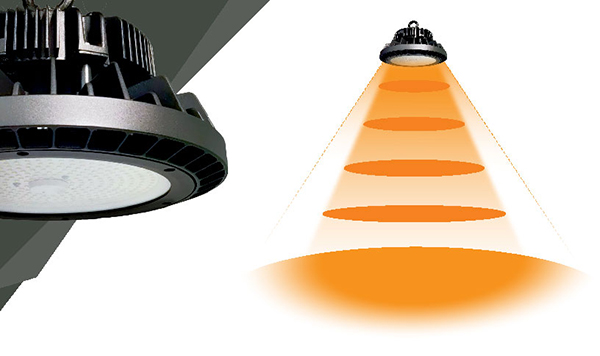
Type II, III, IV, V — each has a specific purpose.
A misapplied optic can create:
- Hot Spots
- Dark Pockets
- Wasted Light
- Poor Peripheral Visibility
Distribution is often the hidden variable that decides whether lighting supports or disrupts operations.
It’s one of the most overlooked — yet most critical — design choices.
6. What environmental factors influence long-term performance?
Temperature swings, humidity, dust, vibration, and run-time cycles all affect lighting behavior.
A fixture that looks great on a spec sheet might perform differently in:
- Cold Warehouses
- High-humidity Corridors
- 24/7 Operations
- Exterior Applications
- Variable-temperature Industrial Areas
Asking the right environmental questions ensures the right fixture is selected — not just a compliant one.
Why these questions matter
Better lighting doesn’t come from oversizing fixtures, adding more brightness, or choosing the highest-lumen version available.
It comes from asking smarter questions — ones that consider:
- How People Move
- How Tasks Are Performed
- How Architecture Shapes Light
- How Future Changes Will Influence Usage
- How Distribution And Uniformity Affect Perception
A thoughtful approach leads to lighting that feels intuitive and supports operations rather than competing with them.
As manufacturers, we see firsthand how these overlooked questions shape the success of a project.
Lighting performance isn’t just about equipment — it’s about understanding the environment it’s built for.
Asking the right questions early helps ensure the system performs predictably, safely, and efficiently for years to come.